
Alaska Conservation Foundation is proud to recognize the following individuals:
Lifetime Achievement Award
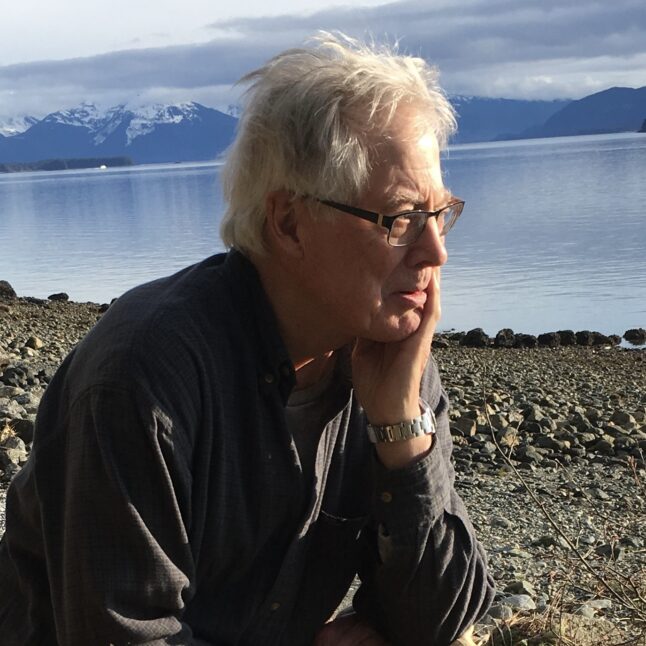
Joel Bennett
Joel’s work has focused on wildlife conservation since coming to Alaska in 1968. As an attorney with the legislature, he crafted early legislation related to wildlife and the environment, later serving on the Alaska Board of Game for 13 years under four different governors. He was Defenders of Wildlife’s first representative for Alaska during the years 1996 to 2003, credited with leading a successful citizen’s initiative to prohibit aerial wolf hunting by the public, among other regulatory reforms. More recently, he has represented the Alaska Wildlife Alliance in successful litigation that held a brown bear predator control program in western Alaska to be unconstitutional. As a wildlife photographer and documentary filmmaker for many years, Joel has directed and filmed over 27 films for television in many parts of the world, featuring such varied subjects as polar bears, caribou, Japanese cranes, and snow leopards. His still photographs have been selected for exhibit at the Alaska State Museum’s “Alaska Positive” competition in four different years, as well as selected for the Rasmuson Foundation’s permanent collection in Anchorage. A new venture into creative writing has resulted in two award-winning children’s books, both true stories, about a man who lived alone on an island with brown bears, and Juneau’s legendary wolf called Romeo. Joel’s goal in this endeavor was to inspire young people to make a difference in wildlife conservation.
Lifetime Achievement Award

Tim Troll
Tim Troll came to Alaska in 1978 as a VISTA volunteer lawyer in Bethel. In 1980 he moved to the small Yup’ik village of St. Marys on the Yukon River and later to the fishing community of Dillingham in Bristol Bay. He and his wife Leanne Goetchius met in Bethel, married, and raised two sons, Keenan and Alex. They now live in Anchorage and cherish their three grandsons. While in Dillingham he initiated the founding of the Bristol Bay Heritage Land Trust. Since 2000 the Land Trust has helped conserve 92,040 acres of private lands, including 21,395 acres in the Wood-Tikchik State Park, and 57,527 acres on Lake Iliamna that also protect the haul-outs for a rare population of freshwater harbor seals. Through the Land Trust he and Ekwok Tribal Chief Luki Akelkok started the annual Bristol Bay Fly Fishing & Guide Academy. Since 2008 the Academy has introduced more than 200 youth to fly fishing, guiding, and conservation in Bristol Bay. In 2014, the Land Trust Alliance selected the Bristol Bay Heritage Land Trust for its National Excellence Award. In 2017, the Land Trust was honored to receive the Lowell Thomas Jr. Award for Outstanding Achievements by a Conservation Organization from the Alaska Conservation Foundation.
Olaus Murie Award for Outstanding Professional Contributions
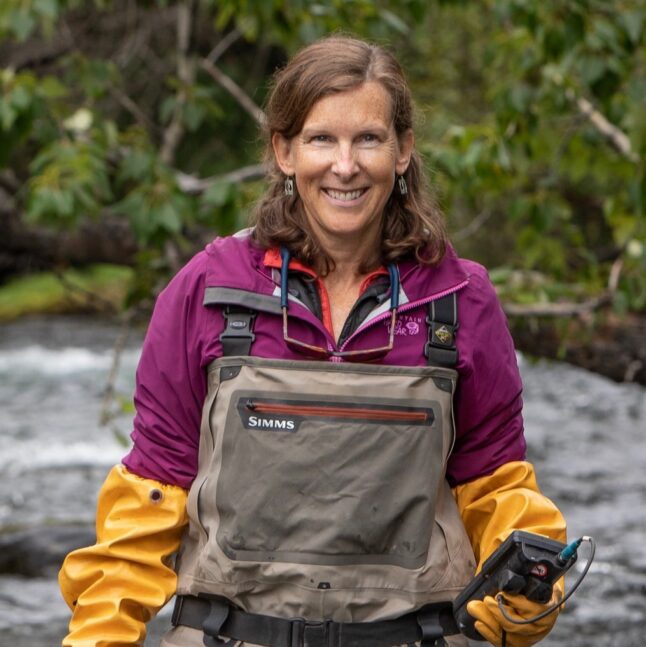
Sue Mauger
Sue has explored climate and land-use change in wild salmon streams since she arrived in Alaska 26 years ago. Motivated by research that can be applied to decision making and public policy, she strives to connect and inspire people, informed by local science, to protect intact landscapes and freshwater habitats. As Cook Inletkeeper’s Science Director and eventual Executive Director, Sue has helped establish protocols to standardize water temperature monitoring across the state; led a regional, multi-partner effort to collect decades of temperature data in Cook Inlet salmon streams; guided and coordinated monitoring networks in other regions of the state; interpreted thermal imagery for hundreds of miles of salmon habitat; published the first regional assessment with climate model projections for Cook Inlet stream temperatures out to 2060; and collaborated on a study that provides the first evidence that declines in many of Cook Inlet’s Chinook salmon populations can be attributed in part to climate-driven changes in their freshwater habitats. Sue has prioritized collaboration among conservation and science professionals in her engagement with Fish Habitat Partnerships across the state, the Alaska Chapter of the American Fisheries Society, and Homeward Bound, a global leadership initiative for women in science. She is a lover of trails, libraries, brass bands, and days spent in waders with her husband and dog by her side.
Daniel Housberg Wilderness Image Award for Excellence in Still Photography, Film or Video

Erin Ranney
Erin is a wildlife cinematographer with specialties in wildlife behavioral filming, remote fieldwork, and deep sea video engineering. Her footage and sequences are seen throughout programs on National Geographic, BBC, PBS, and Smithsonian. She’s filmed extensively in Alaska in the last decade, including a personal film following her family’s stories across remote regions of Alaska and looking at how the landscape, climate, and wildlife have changed in that time. With her family, and herself, being commercial fishermen in Alaska and tree farmers in Washington, she often focuses on conservation messaging in those and similar communities, finding community-based solutions and actions that can be taken. She’s worked on many different conservation campaigns such as “No Pebble Mine.” She hosted a kids’ show on Children’s BBC about climate change and worked with Schoolyard Films on a program about brown bears. She co-founded and chairs the nonprofit Wildlife Cinematographer Diversity Fund, gives free talks to schools and clubs, and volunteers with Girls Who Click in hopes of encouraging and supporting the next generation of conservation storytellers from all backgrounds.
Jerry S. Dixon Award for Excellence in Environmental Education
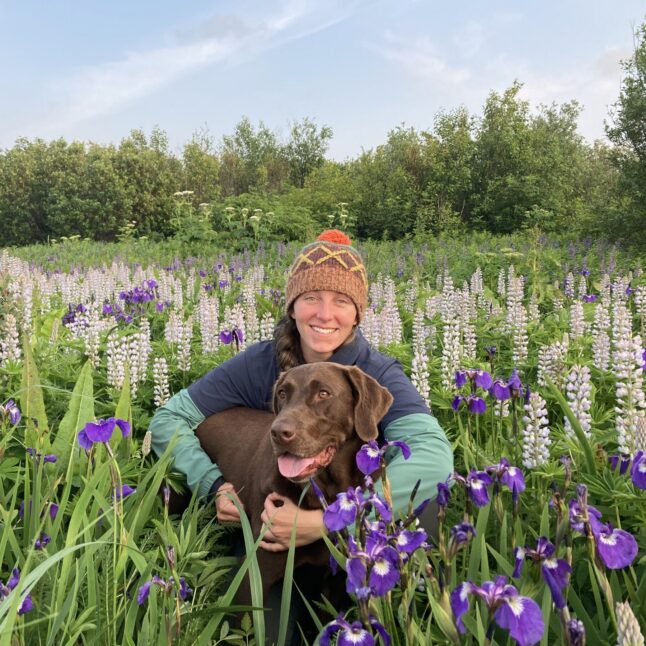
Lauren Bien
Lauren Bien serves as Education Director at the Prince William Sound Science Center in Cordova, where she is lucky to work alongside enthusiastic educators, little and lifelong learners, and committed community partners. While biology, especially marine science, is Lauren’s academic background, experiential education and conservation are her true passions. Using her scientific background, personal experiences from conservation work, knowledge from community partners, and the amazing classroom of the Chugach National Forest, Lauren works to bring scientific depth, lasting impacts, and a sense of wonder into immersive educational programs.
Celia Hunter Award for Outstanding Volunteer Contributions
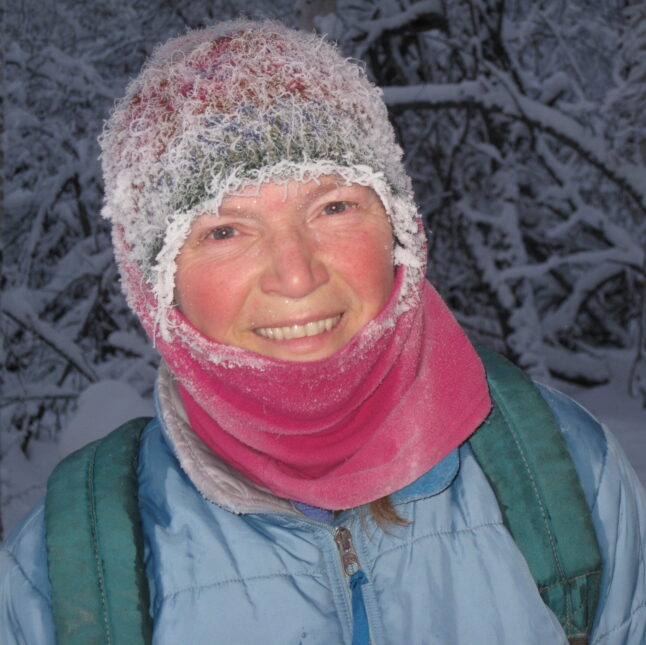
Lou Brown
Lou arrived in Fairbanks from California in 1988 and spent most of her working life writing grant proposals and raising money for an array of nonprofits, including organizations advocating for the deaf community, low-income housing, the environment, and Alaska Native education. She was a board member for Fairbanks’ women’s shelter for 6 years and served as a board member for the Northern Alaska Environmental Center for 8 years. Her current advocacy is with Save Our Domes, working in concert with local property owners seeking to protect their homes and quality of life from the impacts of mining. Her adventures have included building a canoe and paddling a remote river in Guyana, helping build a log cabin on a remote parcel in Prince William Sound, building a home and a successful rental business, and making multiple month-long trips by foot or canoe in the Brooks Range or by kayak in Prince William Sound. Post-retirement, rewarding and joyful new additions to her life include returning to her childhood passions of drawing and painting, playing guitar and singing with friends and in choirs, and finding and refurbishing a 13-foot trailer for more comfortable exploration of our paint-worthy state. At 74, she still loves being outdoors skiing, hiking, kayaking, canoeing, gardening, and picking berries, which, contrary to popular opinion, is a competitive sport.
Lowell Thomas, Jr. Award for Outstanding Achievements by an Organization Doing Conservation Work
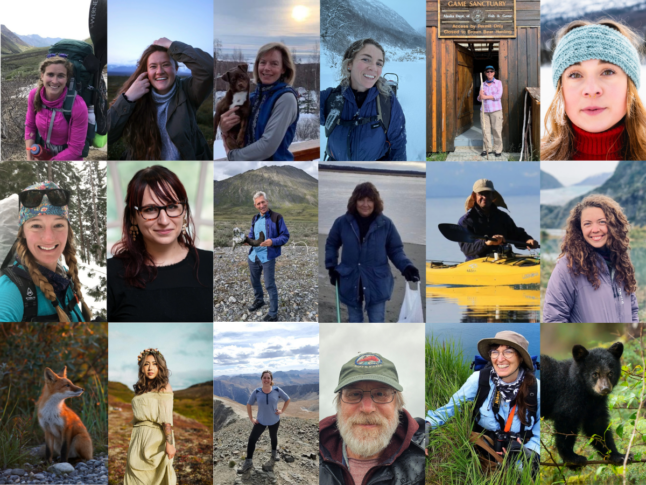
Alaska Wildlife Alliance
Founded in 1978, the Alaska Wildlife Alliance is dedicated to protecting Alaska’s wildlife for its intrinsic value, as well as for the benefit of present and future generations. The Alliance advocates for healthy ecosystems, scientifically and ethically managed to protect Alaska’s wildlife in an increasingly dynamic world. Alaska’s wildlife doesn’t have a voice in the decision-making processes that directly affect them, so the Alliance engages with the public to rally a collective voice for wildlife, bringing the interests of species to the management table. Each year, staff and members attend Board of Game and Board of Fish meetings to advocate for science-based, ethical management of Alaska’s wildlife, and the organization takes legal action to protect wildlife, defend critical habitat, and ensure public agencies follow the law. Members conduct research and produce publications, having co-authored articles on subjects ranging from invasive plant species to migratory birds to the genetics of spruce trees. The Alliance also runs a threatened and endangered species recovery program, focusing on a few species at a time; Alaska is home to 13 endangered species and 8 threatened species, with at least 6 more under consideration for protections. As Alaska’s climate warms three to four times faster than the Lower 48, the Alliance has developed a frontline climate adaptation program, including a Resist-Accept-Direct approach to help sustain biodiversity through rapid ecological change. Through education and citizen science initiatives, the Alliance works to help Alaskans across the state enjoy and protect the most diverse array of wildlife species in the country.

Denny Wilcher Award for Young Environmental Activists
Izzy Brown
Izzy is a local environmentalist, dedicated steward, passionate educator, and inspired researcher, roles she takes on with pride. She calls Denali National Park and Preserve home, the natural environment that sparked her curiosity for advocacy. Having lived, worked, and played on those lands since birth, she has carried that dedication into her time with Alaska Youth for Environmental Action (AYEA), an advocacy council through which she has met a network of like-minded individuals stepping up and taking action for the health of their future land. She was pleased to present at the Alaska Forum and to be a key speaker at the Alaska Natural Resource & Outdoor Education Association. Izzy loves hearing stories of why individuals’ lands matter to them and is appreciative to be this year’s Denny Wilcher Young Environmental Activist of the year.
Caleb Pungowiyi Award for Outstanding Achievements by an Alaska Native Organization or Individual
Chickaloon Traditional Council
Chickaloon Native Village, Nay’dini’aa Na’, meaning “the river with the two logs across it” in Ahtna, is a vibrant, innovative, and culturally rich Ahtna Athabascan Tribe located in Sutton, about a 90-minute drive from Anchorage along the Glenn Highway Scenic Byway. Surrounded by snow-capped mountains, glaciers, and lush boreal forests, the Tribe has occupied this area for the past 10,000 years, though threats to its culture, language, and traditional way of life have been unwavering for the past hundred years. Chickaloon Native Village was one of the first Tribes affected by outside development, with its traditional territories subjected to large-scale resource extraction including coal, copper, and gold mining, oil and gas drilling, and logging, dating as far back as 1900. Alcohol and diseases brought in with development, including polio, tuberculosis, and the Spanish flu, nearly wiped out the Tribe. From the 1930s through the 1950s, the U.S. government enforced a mandatory educational system intended to assimilate Alaska Natives, and many of the Tribe’s children were taken from their families and placed in boarding schools, an experience that left a generation of Elders with a legacy of internalized oppression and shame. In response to this environmental and social injustice, and alongside the passage of the Alaska Native Claims Settlement Act of 1971, the Tribe’s Elders re-established the Chickaloon Village Traditional Council in 1973 to reassert the Tribe’s identity, cultural traditions, economic self-sufficiency, and to reunify its citizens. Chickaloon Native Village gained federal recognition that same year. The Tribe is governed by a nine-member Traditional Council tasked with reasserting the Tribe’s identity and cultural traditions and creating economic self-sufficiency, guided by a mission to perpetuate its ancestors’ beliefs, customs, traditions, and values and to steward its environment so its citizens and community can thrive.